
L = PCK²

If learning is the outcome we care most about, then we need to be precise and honest about what actually creates it. In Further Education, effective teaching has never been simply about knowing a subject or delivering content well. It is about how knowledge is transformed into learning for real people, in real contexts, with complex histories.
This is why Learning (L) = Pedagogical Content Knowledge squared (PCK²).
Not added together.
Not loosely connected.
But multiplied.
Effective FE practice
Pedagogical Content Knowledge has long been understood as the integration of subject expertise and pedagogy, knowing not only what to teach, but how to teach it so that learners can understand, retain and apply it.
In FE, this integration is particularly demanding. Learners arrive with varied prior experiences, interrupted educational journeys, and uneven foundations, alongside rich vocational insight and lived experience. PCK is what allows teachers to translate expert knowledge into something meaningful and learnable.
However, what we see in the most effective FE practice goes beyond this foundational understanding. The strongest teaching is not just knowledgeable and skilled it is intentional, adaptive and deeply responsive. This is where the idea of PCK² becomes powerful.
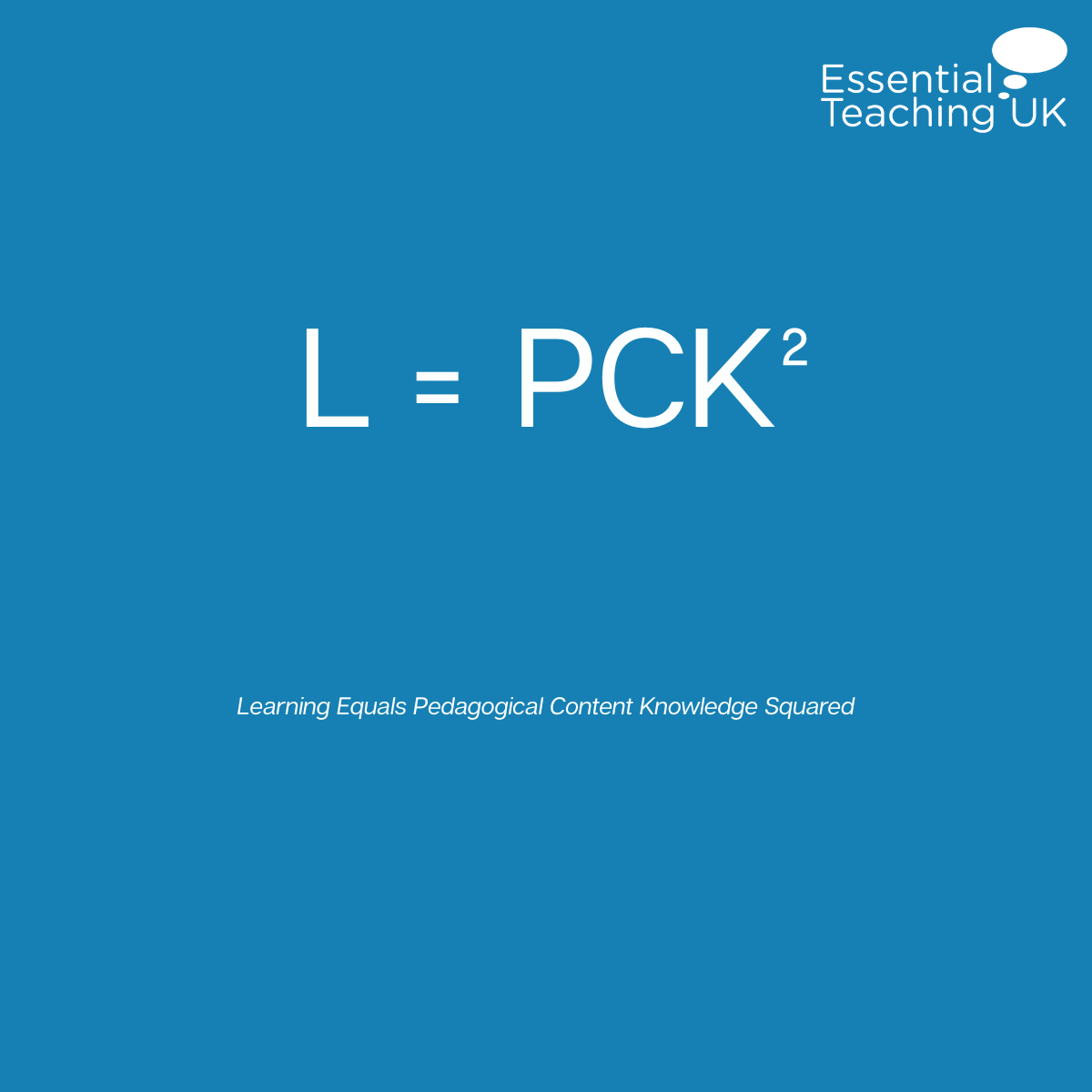
Pedagogical Content Knowledge squared represents the point at which knowledge of subject and pedagogy is combined with professional judgement, learning science and contextual awareness. It is the difference between delivering a lesson and designing learning. Teachers working at this level understand not only which strategies are effective, but when to use them, why they work, and how to adapt them in response to learners in front of them.
The recent publication Powerful Pedagogy: Effective Practice captures this distinction clearly (Link can be found on my website). Across its case studies, effective teaching is not characterised by isolated techniques or performative innovation. Instead, it reveals careful sequencing of knowledge, deliberate attention to learners’ starting points, and pedagogy grounded in evidence rather than habit. Learning is designed cumulatively, with teachers explicitly identifying what is difficult, what is foundational, and what must be revisited over time.
Threshold concepts and troublesome knowledge
A particularly strong thread running through the work is the treatment of threshold concepts and troublesome knowledge. In FE, these concepts are often hidden beneath curriculum specifications or assumed prior learning. Teachers operating with PCK² identify these conceptual gateways and slow learning down when necessary. They design repeated opportunities for learners to encounter, apply and reflect on difficult ideas, understanding that progress often requires productive struggle rather than pace.
Equally important is the way prior knowledge is treated, not as a deficit, but as a diagnostic tool. Powerful pedagogy begins by surfacing what learners already know, including misconceptions, partial understandings and gaps. When new knowledge is explicitly connected to existing schemas, learning accelerates because it becomes coherent. This is not about lowering expectations; it is about securing foundations so learners can move forward with confidence.
What Powerful Pedagogy also makes clear is that teacher learning is the critical multiplier.
PCK² does not develop in isolation. It emerges in cultures where pedagogy is talked about, tested and refined. Where teachers are encouraged to experiment within evidence-informed frameworks, reflect on impact, and learn from one another, practice deepens. Leadership matters here, not as oversight, but as advocacy for teaching as a professional, intellectual endeavour.
Initial Teacher Education
This has significant implications for Initial Teacher Education and ongoing professional development in FE. If we want learning to improve, we must focus less on surface performance and more on how teachers understand learning itself. Teaching quality improves when educators are supported to develop their pedagogical reasoning, not just their delivery skills.
At a time when Further Education plays a critical role in social mobility, workforce development and second chances, this matters more than ever. Learners do not need more content or louder teaching. They need educators who understand how knowledge is built, how confidence is restored, and how learning is sustained over time.
Pedagogical Content Knowledge is essential.
But Pedagogical Content Knowledge squared is transformative.
Learning does not happen by accident. It is designed.
And in Further Education, the most powerful design we have is the adapted PCK².