
Lost in Transmission - Communication and Conceptual Breakthroughs

Giving an ADHD Learner extra time during an activity when they have no concept of time is not effective. Give them a stopwatch!
Effective communication is much more than just talking; it is the cornerstone of successful teaching and learning. It involves not only what we say, but how we use our body language, tone, and digital media to ensure learning is actually taking place. When communication breaks down, we often see the “blank look” a sign of disengagement or confusion that frequently stems from “noise” in the transmission or the complexity of the subject itself.
The Science of the Signal: Shannon and Weaver
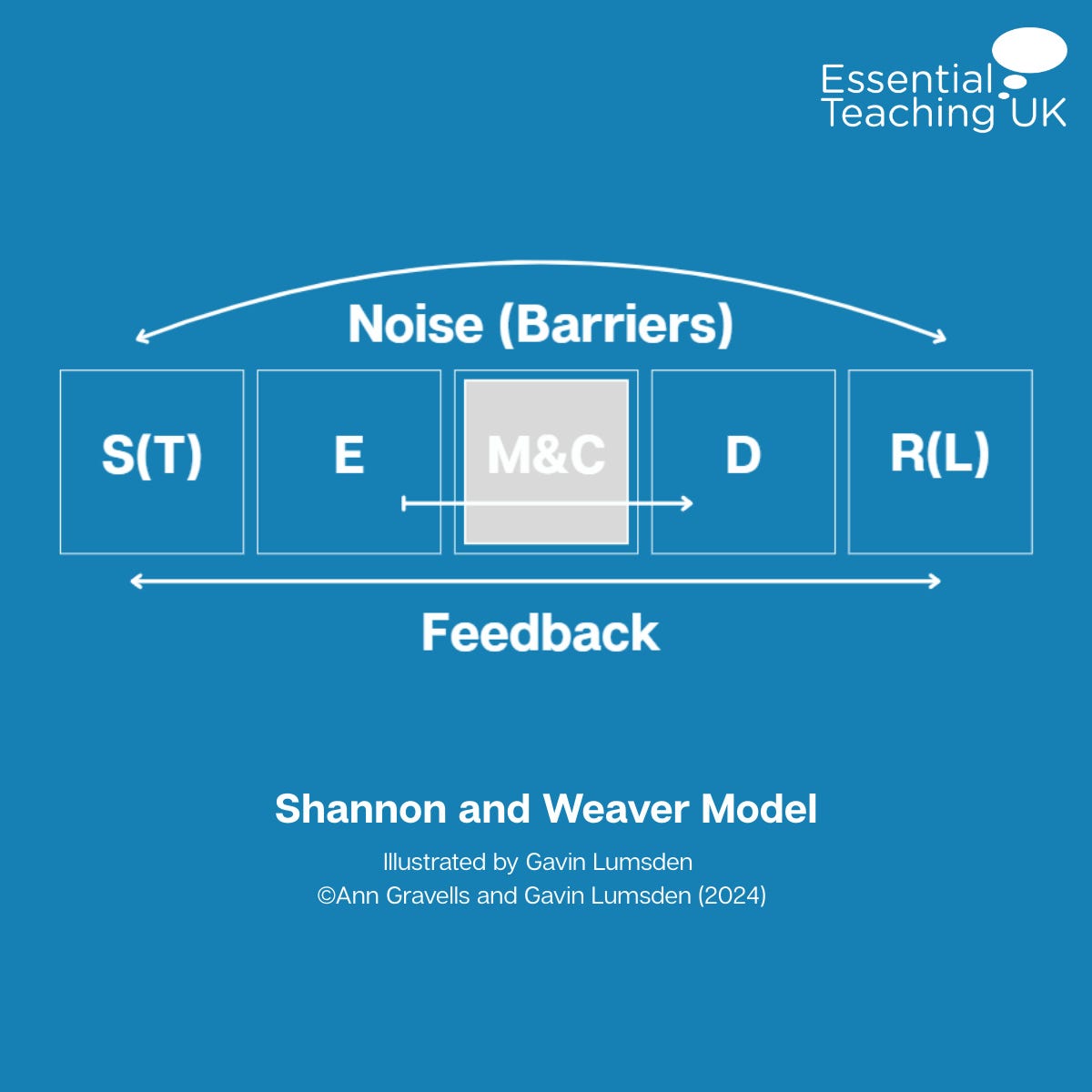
To understand why messages get lost, we use the Shannon and Weaver Model (1949), often called the “Mother of all models”. It describes communication as a linear process:
Sender: The teacher who originates the message.
Encoder: Converting thoughts into signals like spoken words or text.
Message & Channel: The medium used, such as speech, writing, or technology.
Decoder: How the learner converts those signals back into a message they understand.
Receiver: The learner who interprets the final message.
The most critical factor in this model is Noise, any interference that distorts the message during transmission.
Identifying the ‘Noise’ in Your Classroom
Noise in an educational context isn’t just a loud hallway; it falls into four distinct categories that can lead to learner confusion:
Physical: Background sounds, poor Wi-Fi, or environmental issues like flickering lights.
Physiological: Internal barriers for the learner, such as hunger, fatigue, or hearing loss.
Psychological: Emotional barriers including anxiety, personal bias, or a lack of motivation.
Semantic: The use of jargon, complex “Tier 3” vocabulary, or cultural slang that the learner cannot decode.
When the Knowledge Itself is Troublesome
Sometimes, even when the communication is clear, the information acts as its own barrier. David Perkins (1999) describes Troublesome Knowledge as information that is counter-intuitive, alien, or seemingly incoherent. This often manifests in three ways:
Ritual Knowledge: Learners perform a task correctly but don’t understand why they are doing it.
Inert Knowledge: Learners have the facts but cannot apply them to real-world situations.
Conceptual Complexity: The ideas simply contradict common sense, such as those found in higher-level physics or philosophy.
Crossing the Threshold
Troublesome knowledge often leads to Threshold Concepts. A threshold concept is like a learning portal, a door that, once opened, completely transforms a learner’s perspective of the subject. These concepts are transformative, irreversible (hard to un-learn), and integrative (they connect previously hidden dots).
However, before the breakthrough, learners often get “frustrated and stuck” in a state of liminality. This is where the “blank look” is most prominent; it isn’t a failure, but a sign that the learner is currently standing at the threshold.
Practical Strategies for Success
To move learners from “stuckness” to genuine understanding, teachers must actively work to reduce noise and support conceptual breakthroughs.
Reducing Communication Noise
Stopwatch: The 10-2 Rule - Provide 10 minutes of delivery followed by 2 minutes of processing time for the learners.
Jargon Check: Always define “Tier 3” (domain-specific) vocabulary before diving into complex topics.
Keep it Simple: Ensure your communication is accurate, professional, and free of ambiguity or bias.
Supporting Conceptual Breakthroughs
Scaffolding: Break complex concepts into smaller, “low-stakes” chunks.
Analogy Bridge: Use a familiar, everyday concept to explain a new, “alien” idea.
Peer-to-Peer Learning: Encourage a student who has already crossed the threshold to explain the concept to one who hasn’t yet.
By recognising the interplay between communication barriers and the difficulty of new ideas, we can better navigate the “blank look” and lead our learners to a successful conceptual breakthrough.