
Mastering Harvard Referencing

Referencing in Academic Work
Referencing is a cornerstone of academic integrity and scholarly communication. At its heart, referencing is about giving credit where it is due, acknowledging the ideas, research, and words of others that have informed your own work. This practice is not merely a formality; it is a vital part of building credibility, demonstrating ethical conduct, and upholding the standards of research integrity. When you reference correctly, you show your readers that your arguments are grounded in established knowledge, and you provide them with the means to trace your sources for further exploration or verification.
Beyond these practical benefits, referencing is a mark of respect for the intellectual contributions of others. It signals your participation in a wider academic conversation, where ideas are shared, debated, and developed collaboratively. In professional and educational contexts, the ability to reference accurately is a key skill, reflecting your attention to detail and your commitment to ethical scholarship.
Plagiarism and How Referencing Prevents It
Plagiarism, the act of presenting someone else’s work or ideas as your own, is a serious academic offence. It undermines trust, devalues genuine scholarship, and can have severe consequences for students and professionals alike. Plagiarism can occur intentionally, such as copying text without attribution, or unintentionally, through careless paraphrasing or incomplete citations.
Referencing is the primary defence against plagiarism. By clearly indicating which ideas are yours and which are drawn from other sources, you maintain transparency and honesty in your work. Proper referencing also allows you to engage critically with source material, whether you are quoting directly, paraphrasing, or synthesising information from multiple authors. In this way, referencing is not just a technical requirement but a fundamental aspect of academic integrity.
Harvard Referencing System: Structure and Conventions
The Harvard referencing system is one of the most widely used citation styles in academia, particularly in the UK and Australia. It is characterised by its use of the author-date format, which makes it easy for readers to locate sources quickly. In Harvard referencing, citations are provided in two places: within the text (in-text citations) and in a reference list at the end of your work.
In-text citations typically include the author’s surname and the year of publication, for example: (Smith, 2020). If you are quoting directly, you should also include the page number: (Smith, 2020, p. 45). The reference list provides full details of each source, enabling readers to find the original material.
Consistency is crucial in Harvard referencing. All citations and references should follow the same format throughout your work. While there may be slight variations in style depending on institutional guidelines, the core principles remain the same: clarity, accuracy, and completeness.
Distinguishing Between a Reference List and a Bibliography
It is important to understand the difference between a reference list and a bibliography, as these terms are sometimes used interchangeably but have distinct meanings in academic writing. A reference list includes only the sources that you have cited directly in your work. Each entry corresponds to an in-text citation, and the list is arranged alphabetically by author surname.
In contrast, a bibliography includes all the materials you have consulted during your research, whether or not you have cited them in your text. This might include background reading, sources that informed your understanding, or works you found useful but did not reference directly. Some institutions require both a reference list and a bibliography, while others may allow you to combine them under a single heading, such as “References and Bibliography.” Always check your assignment guidelines for specific requirements.
How to Reference Books: Author, Publication Date, Page Numbers, and Formatting
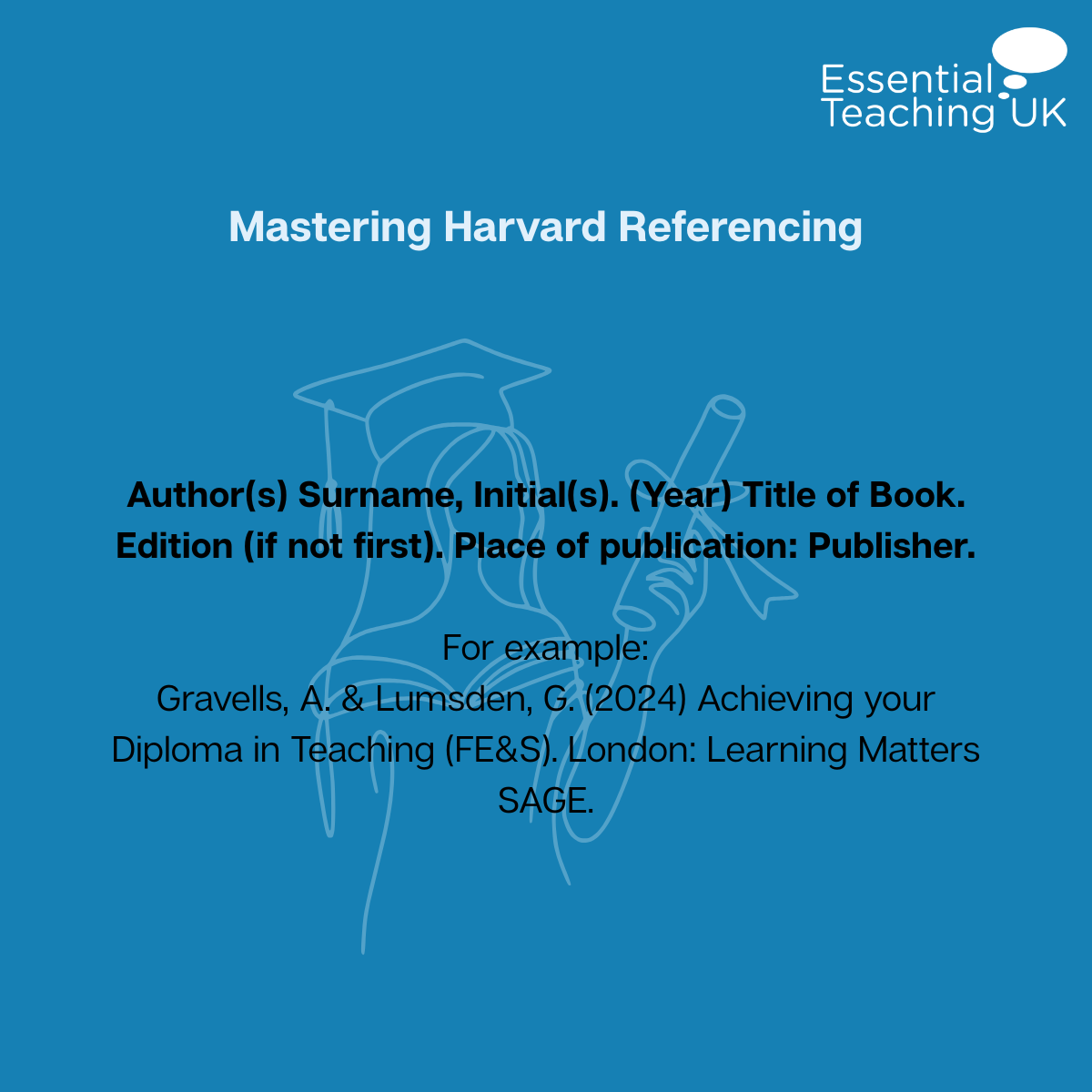
Referencing a book in the Harvard system involves several key elements: the author’s surname and initials, the year of publication, the title of the book (in italics or underlined), the edition (if not the first), the place of publication, and the publisher. Here is the standard format:
Author(s) Surname, Initial(s). (Year) Title of Book. Edition (if not first). Place of publication: Publisher.
For example:
Gravells, A. & Lumsden, G. (2024) Achieving your Diploma in Teaching (FE&S). London: Learning Matters SAGE.
When quoting directly from a book, include the page number in your in-text citation: (Gravells & Lumsden, 2024, p. 52). If you are paraphrasing, the page number is optional but recommended for clarity.
Referencing Online Sources: Websites and Online Reports
With the increasing use of digital resources, it is essential to know how to reference websites and online reports accurately. For websites, the in-text citation should include the organisation or author and the year of publication or last update: (ETF, 2016). In your reference list, provide the full URL and the date you accessed the site, as web content can change or be removed over time.
The format for a website reference is:
Author/Organization (Year) Title of Webpage. Available at: URL (Accessed: Month Year).
For example:
Professional Standards for Teacher and Trainers. www.et-foundation.co.uk/professional-standards/teachers (accessed April 2026)
Quoting, Paraphrasing, and Integrating References into Your Writing
Effective academic writing involves more than simply inserting quotes or citations. It requires you to engage critically with your sources, integrating them smoothly into your own arguments. There are three main ways to use sources:
Quoting: Use the exact words from a source, enclosed in quotation marks, and include an in-text citation with the page number. For example: “The role of a teacher extends far beyond just imparting knowledge...” (Gravells & Lumsden, 2024, p. 24).
Paraphrasing: Restate the information from a source in your own words. This demonstrates your understanding and allows you to tailor the information to your argument. Always cite the source, even when paraphrasing.
Summarising: Condense the main ideas of a source into a brief overview, again with appropriate citation.
When integrating references, aim for a balance between your own analysis and the supporting evidence from your sources. Avoid over-reliance on direct quotes; instead, use paraphrasing and summarising to demonstrate your grasp of the material.
Using Multiple Sources and Strategic Reading for Effective Research
Academic research is most robust when it draws on a range of sources. Using multiple references allows you to compare perspectives, identify trends, and build a more nuanced argument. Strategic reading, such as using indexes, skimming abstracts, and focusing on key chapters can help you manage large volumes of information efficiently.
When referencing multiple sources, cite them in alphabetical order within the same parentheses, separated by semicolons: (Day et al., 2006; Gravells, 2017; Reece & Walker, 2007). This approach demonstrates the breadth of your research and strengthens your credibility as a writer.
Practical Application: Creating Accurate In-Text Citations and Compiling a Reference List
To put these principles into practice, follow these steps:
As you write, insert in-text citations immediately after the information you have sourced from others.
Keep a running list of all sources you cite, ensuring you record full publication details.
At the end of your work, compile your reference list in alphabetical order by author surname.
Double-check each entry for accuracy and consistency with the Harvard format.
Attention to detail at each stage will save you time and prevent errors later on. Many institutions provide referencing guides or recommend tools such as citation generators, but always review the output for accuracy.
Common Mistakes and How to Avoid Them in Harvard Referencing
Even experienced writers can make mistakes in referencing. Some of the most common errors include:
Omitting page numbers for direct quotes
Inconsistent formatting (e.g., varying use of italics or punctuation)
Missing or incomplete reference list entries
Failing to update access dates for online sources
Confusing a reference list with a bibliography
To avoid these pitfalls, develop a habit of checking your references as you go. Use institutional guides, seek feedback from tutors, and review examples of correctly formatted references. Remember, accurate referencing is a skill that improves with practice and attention to detail.
Building Academic Integrity Through Referencing
Mastering the Harvard referencing system is more than a technical requirement, it is a vital part of your development as a reflective, ethical, and credible academic or professional. By understanding the principles behind referencing, practising accurate citation, and engaging critically with your sources, you contribute to a culture of integrity and excellence in your field.
As you continue your studies and professional practice, let referencing be a tool for learning, discovery, and scholarly growth.