
Should We RAG Rate Teaching Practice Observations?
Despite this shift, many organisations use some form of RAG rating system Red, Amber, Green during Teaching Practice Observations.

We do, within the Level 5 Diploma in Teaching (FE & SKills) at Essential Teaching UK…
Within Further Education and Skills, lesson observations have changed significantly over recent years. The sector has moved away from high-stakes graded observations towards approaches centred on coaching, professional dialogue, and reflective practice.
Should RAG Rating Exist?
The debate is not simply about whether RAG ratings should exist, but about how they are used and the impact they have on teachers, confidence, and learner outcomes.
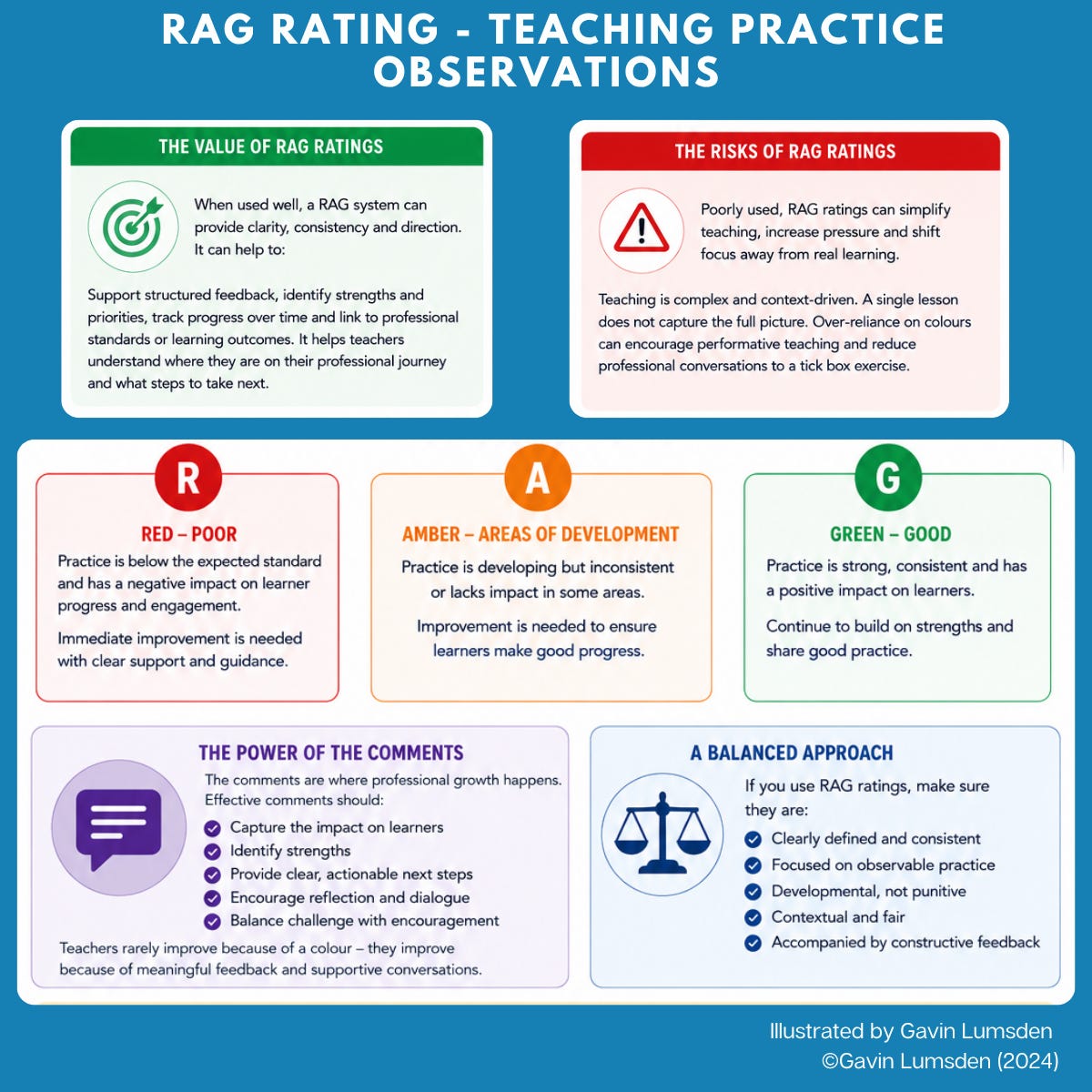
When used effectively, a RAG system can provide clarity and structure. For trainee teachers and early career educators, it offers a straightforward way to understand strengths and identify areas for development. A well-designed RAG process can support meaningful feedback conversations, help observers track progress over time, and provide a consistent framework linked to professional standards or learning outcomes.
In this context, Green reflects secure and effective practice, Amber highlights areas requiring further development, and Red identifies practice needing immediate support. Used developmentally, the system can help teachers recognise where they are in their professional journey without becoming overwhelmed by formal grading systems.
Simplifying Practice or Not?
Teaching is complex, relational, and highly contextual. Reducing a lesson observation to a colour can oversimplify practice and fail to capture the full picture of an teacher’s impact. A teacher may receive an Amber rating because pacing or assessment strategies need refinement, while still maintaining exceptional learner relationships and creating meaningful long-term progress.
The greatest risk is when the rating becomes more important than the conversation behind it. Poorly implemented observation systems can create anxiety, encourage performative teaching, and shift the focus from authentic learning to compliance. Observations should never feel like inspections designed to “catch teachers out.” They should feel like opportunities for reflection, experimentation, and professional growth.
Feedback Matters
This is why the quality of feedback matters far more than the colour itself. The comments section of an observation is often the most powerful element of the process. Constructive comments capture the impact on learners, acknowledge strengths, and provide clear next steps for improvement. Teachers rarely improve because of a colour rating alone; they improve through supportive conversations, coaching, and reflective practice.
If organisations choose to use RAG ratings, they must ensure the process is developmental rather than punitive. Observers need consistency, professionalism, and the ability to balance challenge with encouragement. An Amber rating, in particular, should not be viewed negatively. In many cases, Amber represents the space where the most valuable professional learning takes place.
Improving the learning
Ultimately, Teacher Practice Observations should focus on improving the learner experience and supporting educators to develop confidence, creativity, and professional identity. Whether a provider chooses to RAG rate or not, the purpose of observation should remain the same:
“to help teachers grow, refine their practice, and positively impact learners”.
Perhaps the real question is not, “Should we RAG rate teacher practice?” but instead, “How can observations best support professional growth?”